


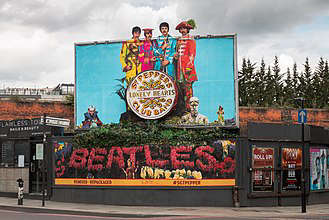
John Lennon turned a mundane newspaper story about potholes into one of The Beatles’ most surreal and iconic songs
Few songs in popular music history capture the surreal, fragmented essence of modern life quite like “A Day in the Life” by The Beatles. Released in 1967 as the final track on Sgt. Pepper’s Lonely Hearts Club Band, the song has been celebrated for its ambitious structure, experimental sound, and haunting lyrics. Yet one of its most iconic moments begins with a simple, almost casual reference to the news:
"I read the news today, oh boy / Four thousand holes in Blackburn, Lancashire / And though the holes were rather small / They had to count them all / Now they know how many holes it takes to fill the Albert Hall / I'd love to turn you on."
This verse, penned by John Lennon, was inspired by an actual newspaper article. In 1967, the Daily Mail reported that the streets of Blackburn, a town in Lancashire, England, were riddled with potholes — over four thousand of them. Lennon, known for his keen eye for the absurd and the poetic potential of everyday life, turned the mundane and bureaucratic counting of potholes into a surreal meditation on modern existence. The leap from local road maintenance to filling the Albert Hall reflects the playful, dreamlike logic that defines much of Lennon’s songwriting: a tiny fact becomes a symbol for the overwhelming, sometimes absurd scale of life.
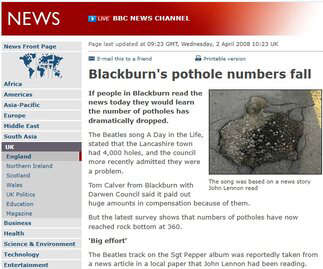
Paul McCartney contributed the second, contrasting section of the song, which captures a more domestic, grounded perspective — a morning routine, a cup of tea, and the small actions that make up daily life. This stark juxtaposition between Lennon's cosmic imagery and McCartney's ordinary world is central to the song’s brilliance, creating a musical narrative that mirrors the way real life oscillates between the extraordinary and the banal.
Recording “A Day in the Life” was equally groundbreaking. The song features a combination of techniques that were rare for the time: a 40-piece orchestra, layered tape loops, and innovative studio effects. The swelling orchestral piece, added at producer George Martin’s suggestion, were intended to erupt from the song’s calm, orderly verses, creating a sense of chaotic release.
Lennon’s final piano chord, held for over forty seconds, adds to the song’s sense of unresolved tension — an auditory representation of the ambiguity and unpredictability of life itself.
The “four thousand holes” lyric, in particular, exemplifies how Lennon transformed a specific, almost trivial news item into a commentary on the collective human experience. It’s a reflection of the 1960s counterculture’s fascination with the interplay between reality and perception, and the notion that ordinary events could hold hidden significance when viewed through a creative lens. The song, and especially this verse, blurs the lines between literal reporting and artistic interpretation, showing Lennon’s gift for storytelling and metaphor.
Over the decades, “A Day in the Life” has continued to resonate, cited as one of The Beatles’ most ambitious achievements. The song captures the tension between public events and private consciousness, between the trivial and the profound. The simple newspaper clipping about holes in Blackburn became, through Lennon’s imagination, a meditation on mortality, modernity, and the human desire to find meaning in the chaos of everyday life.
In the end, the brilliance of “A Day in the Life” lies not just in its sonic innovation, but in its ability to transform the mundane into the extraordinary. The story of the four thousand holes in Blackburn is emblematic of The Beatles’ larger genius: the ability to take a fragment of reality and, through music, magnify it into something timeless, surreal, and profoundly human.
Sources:
MacDonald, Ian. Revolution in the Head: The Beatles' Records and the Sixties. Pimlico, 2005.
- Sheff, David. All We Are Saying: The Last Major Interview with John Lennon and Yoko Ono. St. Martin’s Press, 2000.
- Everett, Walter. The Beatles as Musicians: Revolver through the Anthology. Oxford University Press, 1999.
- Miles, Barry. Paul McCartney: Many Years From Now. Henry Holt & Co., 1997.
- Lewisohn, Mark. The Complete Beatles Recording Sessions. Harmony Books, 1988.
Image: This file is licensed under the Creative Commons Attribution-Share Alike 4.0 International license. Author: Kreepin Deth
 New Music Monday: Five Tracks that look to the return of the sun
 World Radio Day - Radio's Enduring Power: Past, Present, Future
 Huntsville Festival of the Arts to Feature David Suzuki in Hybrid Theatre Performance
 Mississippi Rock Legend Brad Arnold, Voice of 3 Doors Down, Dies at 47












Comments
Add a comment