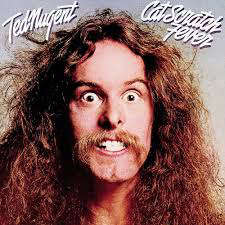
Driven by a unique jazz guitar and a roaring public persona, Ted Nugent’s masterpiece "Cat Scratch Fever" cemented the "Motor City Madman" as an arena rock icon
In the landscape of 1970s heavy rock, few figures projected as much unbridled, hyper-kinetic energy as Ted Nugent. Known widely as the "Motor City Madman," the Detroit-born guitarist spent the first decade of his career grinding through the Midwestern circuit, first with his adolescent band The Lourds and later with the psychedelic rock outfit The Amboy Dukes. While The Amboy Dukes scored a major national hit in 1968 with the psychedelic anthem "Journey to the Center of the Mind"—a track Nugent maintained he had no idea carried drug connotations due to his own strict lifestyle—it was not until he dropped the band name entirely in 1975 that his solo trajectory skyrocketed.
After signing with Epic Records as a solo artist, Nugent unleashed a trio of multi-platinum albums: Ted Nugent in 1975, Free-for-All in 1976, and finally, the crowning achievement of his commercial career, Cat Scratch Fever, released on May 13, 1977.
The title track and lead single of the album quickly cemented itself as Nugent’s definitive musical calling card. Recorded between January and March at Columbia Recording Studios in New York and CBS Studios in London, the song was built around an exceptionally heavy, syncopated blues-rock guitar riff.
Nugent’s trademark heavy sound stemmed primarily from his unconventional choice of instrument. While most hard rock guitarists of the era gravitated toward solid-body guitars like the Gibson Les Paul or Fender Stratocaster to minimize unwanted noise at high volumes, Nugent chose a Gibson Byrdland. The Byrdland is a thin, hollow-body archtop guitar traditionally favored by jazz musicians. Inspired by seeing Detroit guitarist Jim McCarty use one, Nugent cranked the hollow-body instrument to maximum volume through a wall of amplifiers. Rather than eliminating the intense acoustic feedback caused by the hollow body, Nugent learned to manipulate it, using the resonance to create an aggressive, roaring wall of sound that became his trademark.
Under the production team of Lew Futterman, Tom Werman, and Cliff Davies, "Cat Scratch Fever" captured that focused ferocity. Unlike many tracks on the album that featured the returning powerhouse vocalist Derek St. Holmes on lead vocals, Nugent took the microphone himself for the title track, delivering the swaggering lyrics with an urgent, snarling cadence.
Released as a single in July, "Cat Scratch Fever" became an immediate staple on American FM rock radio. The song tapped into the post-psychedelic appetite for straightforward, high-octane guitar anthems, driving the Cat Scratch Fever LP to peak at number 17 on the US Billboard 200 album chart.
As a standalone single, the track achieved the highest chart position of Nugent’s solo career on the flagship US Billboard Hot 100, peaking at number 30. It also made a significant international impact, reaching number 37 on the Canadian RPM Top Singles chart. The immense airplay and heavy sales propelled the album to triple-platinum status in the United States, representing more than three million copies shipped, alongside a platinum certification in Canada. Decades later, the song's cultural footprint remained strong enough to inspire a heavy metal cover by the band Pantera in 1999 for the Detroit Rock City movie soundtrack. Nugent later criticized their rendition for lacking the soulful blues feel of his original recording.
Beyond the commercial triumph of his music, Nugent became equally famous for a calculated, outrageous public persona and a lifestyle that defied typical rock-and-roll stereotypes. At a time when the rock industry was notoriously fueled by substance abuse, Nugent maintained strict, lifelong sobriety from drugs and alcohol. He frequently used his platform to campaign against substance abuse, declaring that the lifestyle choices of his peers often led down a destructive path.
Nugent's musical career started remarkably early. He received an unclaimed acoustic guitar left on an airplane at age nine, took formal lessons, and by age 13, his first band, The Lourds, was winning local talent competitions and even opening for major acts like The Supremes at Detroit's Cobo Hall.
On stage, Nugent fully leaned into his wild moniker. Sporting an iconic mane of long hair, his wardrobe routinely consisted of loincloths, deerskin, and animal fringe. He became famous for jumping off massive stacks of amplifiers and playing at extreme decibels. This prolonged exposure to immense volume eventually caused severe, permanent hearing loss, leaving Nugent legally deaf in his left ear.
Nugent’s relationship with the military draft during the Vietnam War became a long-standing piece of rock lore, primarily due to conflicting accounts from the artist himself. In a notorious 1977 interview with High Times and a later 1990 interview with the Detroit Free Press, Nugent claimed he avoided conscription through extreme, unhygienic methods designed to intentionally fail his physical examination. However, in subsequent decades, Nugent completely recanted these stories, claiming he fabricated the outrageous details to shock and amuse the rock journalists of the era. Official Selective Service records indicate that Nugent initially received standard 1-Y student deferments while enrolled at Oakland Community College in 1967 and 1968, before ultimately being reclassified as 4-F, meaning he was deemed unqualified for military service following a standard physical examination in 1969.
Ultimately, "Cat Scratch Fever" remains a masterclass in 1970s hard rock construction. Fueled by a controlled-feedback jazz guitar, a relentless rhythm section, and an unmistakable attitude, the song took a regional Detroit guitarist and secured his place in American arena rock history.
Sources:
- Epic Records
- Billboard Hot 100
- Wikipedia
- High Times Magazine
- Detroit Free Press
- The Guardian
 Jack, Diane, and the Summer of '82: How John Mellencamp Made Chart History
 How Toots Hibbert Gave Reggae Its Name and Soul
 On This Day: Nirvana’s ‘Smells Like Teen Spirit’ Rewrites Rock History
 New Art Exhibition Puts a Human Face on Huntsville’s Food Insecurity
 Light 'Em Up: Zippo's Ultimate Lighter-in-the-Air Anthem






Comments
Add a comment