


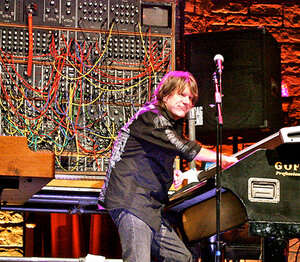
A tribute to Keith Emerson, the progressive rock titan who turned the synthesizer into a weapon of classical rebellion
The stage was often a battlefield for Keith Emerson. In the 1970s, he didn’t just play the Hammond L-100 organ; he wrestled it, stabbed it with knives to hold down notes, and let it howl in feedback while he somersaulted over the keys. He was the Jimi Hendrix of the keyboard, a man who dragged the pipe organ and the Moog synthesizer out of the conservatory and into the strobe-lit chaos of the rock arena.
But on March 11th, 2016, the bravado that defined a generation of progressive rock had been replaced by a quiet, agonizing struggle. At 71, in his home in Santa Monica, the pioneer who had bridged the gap between Johann Sebastian Bach and the Moog synthesizer took his own life. It was a tragic finale for a man whose hands had once commanded the sonic equivalent of a thunderstorm.
Emerson’s journey began with The Nice, where his fusion of jazz, blues, and classical music first shocked the UK scene. However, his legacy was truly forged in 1970 with the formation of the ultimate supergroup: Emerson, Lake & Palmer (ELP). Alongside King Crimson bassist/vocalist Greg Lake and Atomic Rooster drummer Carl Palmer, Emerson created a sound that was as intellectual as it was deafening.
Their self-titled debut introduced the world to "Lucky Man," featuring a hauntingly primitive yet futuristic Moog solo that became an instant radio staple. From there, the trio embarked on a run of eight albums that redefined the limits of a three-piece band. They didn't just write songs; they constructed epics.
In "Tarkus," a side-long suite about a mechanical armadillo-tank, Emerson’s mastery of odd time signatures was on full display. In "Karn Evil 9," he invited listeners to a dystopian carnival with the iconic line, "Welcome back, my friends, to the show that never ends." Their peak commercial moment came in 1977 with a triumphant, bombastic reimagining of Aaron Copland’s "Fanfare for the Common Man." It climbed to No. 2 on the UK charts, proving that a nine-minute instrumental based on 20th-century classical music could still dominate the airwaves.
Yet, the very thing that brought Emerson to the heights of the charts—his legendary virtuosity—became his greatest burden. In his later years, he suffered from focal dystonia and nerve damage in his right hand. For a man who lived to perform at the edge of human capability, the prospect of an upcoming tour in Japan filled him with a paralyzing "performance anxiety."
His partner, Mari Kawaguchi, later noted that Keith felt he wasn't good enough anymore, despite the world still viewing him as a titan. He was a perfectionist trapped by the physical limitations of a body that could no longer keep pace with his brilliant, frantic mind.
Keith Emerson didn't just play music; he built cathedrals of sound. While his end was marked by a private darkness, his life’s work remains a vivid, roaring testament to the idea that rock and roll could be as complex as a symphony and as wild as a riot.
Sources:
- The Guardian
- Rolling Stone
- Billboard
- Official Charts Company
- Emerson, Lake & Palmer
Image: This file is licensed under the Creative Commons Attribution-Share Alike 3.0 Unported license. Author: Mari Kawaguchi
 Jack, Diane, and the Summer of '82: How John Mellencamp Made Chart History
 How Toots Hibbert Gave Reggae Its Name and Soul
 On This Day: Nirvana’s ‘Smells Like Teen Spirit’ Rewrites Rock History
 New Art Exhibition Puts a Human Face on Huntsville’s Food Insecurity
 Light 'Em Up: Zippo's Ultimate Lighter-in-the-Air Anthem








Comments
Add a comment