

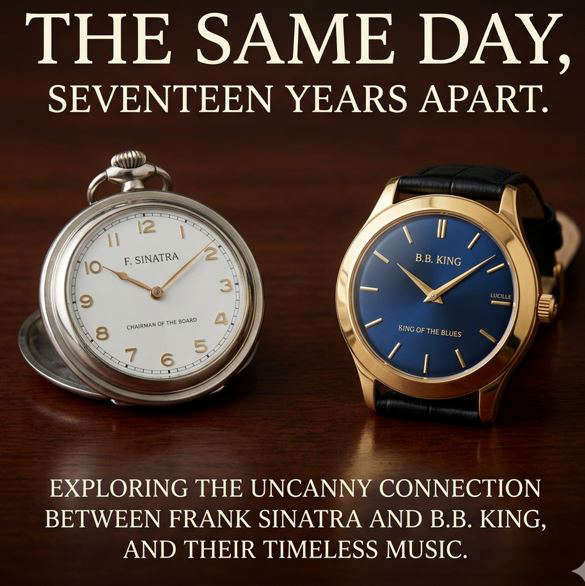
On the same calendar day, seventeen years apart, the world lost the undisputed Chairman of the Board and the reigning King of the Blues. We explore the uncanny connection between Frank Sinatra and B.B. King, and the timeless music they left behind.
History has a strange way of syncing the clocks for its most legendary figures. Every May 14th, the music world pauses to mark a double anniversary of silence. It is the day the Blue Eyes of Hoboken finally closed, and the day the Lucille of Indianola went quiet forever. Frank Sinatra passed away on May 14, 1998; B.B. King followed him into the great beyond on May 14, 2015.
On the surface, they were worlds apart. Sinatra was the pinnacle of mid-century cool, the tuxedo-clad titan who owned the Las Vegas strip with a snap of his fingers and a martini in hand. B.B. King was the sharecropper’s son from Mississippi, a man who spent decades on a tour bus, sweating through his jacket while coaxing Lucille—his Gibson ES-355—into making the guitar weep.
Yet, beyond the surface, a deep, rhythmic thread tied them together. Both men were the ultimate architects of the phrased note. Sinatra didn't just sing a lyric; he lived inside the vowels, using breath control he learned from watching trombonists to make a song like In the Wee Small Hours of the Morning feel like a private confession. B.B. King did the exact same thing with six strings. When he struck that first stinging note of The Thrill Is Gone, it wasn't just a sound—it was a vocalization. He famously said he couldn't sing and play at the same time because the guitar was his second voice.
Both legends shared a profound respect for the lonely hours of the night. Sinatra’s saloon songs like One for My Baby (and One More for the Road) painted the portrait of the heartbroken man at the end of the bar. B.B. King’s catalog, particularly the soulful Sweet Little Angel, spoke to the same universal ache. They were both masters of the blue mood—Sinatra through the lush arrangements of Nelson Riddle, and King through the raw, vibrato-heavy stings of the Delta.
Interestingly, their paths did more than just cross in the record bins. In the late 1950s and 60s, both men played a crucial role in breaking the color barrier in Las Vegas. Sinatra famously refused to play at hotels or casinos that wouldn't allow his Black contemporaries, like Sammy Davis Jr. or Count Basie, to stay as guests. B.B. King, who fought his way through the Chitlin' Circuit to become a global ambassador, eventually found a home on those very same Vegas stages, often performing in the showrooms Sinatra helped integrate.
As we look at the calendar today, May 14th, we see more than just a date of mourning. We see the bookends of a golden era. Whether you are listening to the triumphant brass of My Way or the sophisticated groove of Every Day I Have the Blues, you are hearing the work of two men who refused to be anything but original.
The Chairman and the King took their final bows on the same day, but their music continues to play in the wee small hours of our collective memory, ensuring that on May 14th, the song never truly ends.
Sources:
- The New York Times
- Rolling Stone
- B.B. King Museum
- Sinatra.com
- PBS American Masters
- The Guardian
 Jack, Diane, and the Summer of '82: How John Mellencamp Made Chart History
 How Toots Hibbert Gave Reggae Its Name and Soul
 On This Day: Nirvana’s ‘Smells Like Teen Spirit’ Rewrites Rock History
 New Art Exhibition Puts a Human Face on Huntsville’s Food Insecurity
 Light 'Em Up: Zippo's Ultimate Lighter-in-the-Air Anthem







Comments
Add a comment