


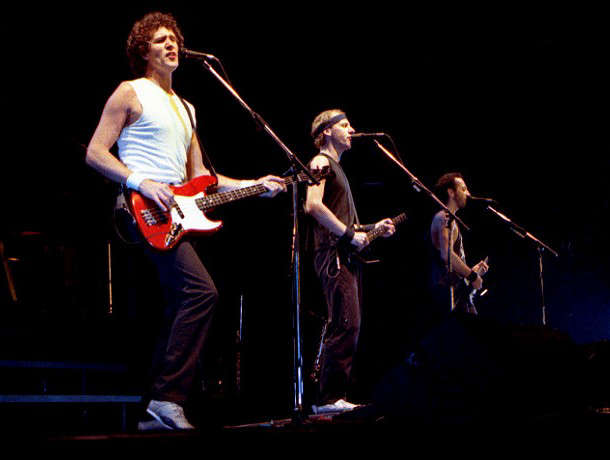
How a dreary, rain-soaked night in a South London pub and a second-hand Stratocaster rescued a penniless band and birthed one of rock’s most transcendent anthems
The rain was coming down in sheets over Deptford, a working-class neighborhood tucked into the southeastern curve of the River Thames. It was 1977, and Mark Knopfler—a 28-year-old former newspaper reporter turned struggling musician—was ducking into a local pub to escape the squall and grab a cold pint.
Inside, the atmosphere was as dreary as the weather outside. In the corner stood a tired Dixieland jazz band, blowing dutifully into brass instruments for a room that was nearly vacant, save for a handful of teenagers playing pool in platform shoes and high-waisted baggies, completely oblivious to the music. The band was mediocre, the audience nonexistent. Yet as the final uninspired chord died away, the trumpet player stepped up to the microphone and announced with deadpan sincerity: “Goodnight and thank you. We are the Sultans of Swing.”
Knopfler grinned. The absurd gap between their majestic moniker and their bleak reality stuck with him as he trudged back through the downpour to the drafty council flat he shared with his younger brother David and bassist John Illsley.
At the time, the trio—along with drummer Pick Withers—were living on the razor’s edge of poverty. "We were living on next to nothing and couldn't even pay the gas bill," Illsley remembered years later. They had recently christened themselves Dire Straits—a literal assessment of their financial reality.
Sitting on the floor of the flat, Knopfler picked up a National Steel acoustic guitar and began hammering out a narrative based on the pub band. He populated the song with vivid, blue-collar characters: Harry, who holds down a day job but "holds everything" when he steps up to play, and Guitar George, who knows all the chords but strictly refrains from making his instrument "cry or sing."
Yet in its original acoustic form, the song lacked a heartbeat. "I thought it was dull," Knopfler admitted.
The turning point arrived when Knopfler scraped together enough money to acquire a red 1961 Fender Stratocaster. The moment he plugged the electric guitar into a Fender Twin amplifier and flicked the three-way selector switch into the middle position, the song transformed. The light, clean single-coil pickings unleashed a fluid, ringing tone. Knopfler abandoned a standard plectrum, using his bare thumb and fingers to snap the strings, creating a rhythmic, cascading sound that bridged classical fingerstyle with electric blues. The song shifted into double-four time at 149 beats per minute, built on a descending D-minor Andalusian cadence.
By July 1977, Dire Straits managed to pull together £120 to book time at Pathway Studios, a cramped eight-track basement studio in North London, to cut a five-track demo that included "Sultans of Swing." Seeking nothing more than an expert opinion, they dropped off the reel to Charlie Gillett, presenter of the influential Honky Tonk program on BBC Radio London. Gillett was so taken with the track that he spun it live on air that very afternoon. The response was immediate: the station's switchboard lit up with eager callers, and A&R talent scouts from Phonogram Records immediately set out to sign the unknown group.
When Dire Straits went into Basing Street Studios to cut their self-titled debut album with producer Muff Winwood, they encountered a bizarre dilemma: they struggled to replicate the magic of their raw £120 demo. "The problem we had was that we couldn't get 'Sultans of Swing' to sound as good as the demo," Illsley recalled. "There was even a time when the demo was being considered as the single."
They eventually captured the master take—complete with Knopfler’s blistering, finger-picked final solo, a fluid display of arpeggios, hammer-ons, and quick bends that would go down as one of the most celebrated guitar solos in rock history.
Released in May 1978, the single initially sputtered in the UK. But as radio stations in Holland and the United States picked it up, momentum exploded. By 1979, "Sultans of Swing" was a Top 10 smash on both sides of the Atlantic, propelling the band's debut album to multi-platinum status and launching Dire Straits toward world-domination arena tours. Even Bob Dylan took notice, immediately hiring Knopfler and Withers to play on his 1979 album Slow Train Coming.
Decades later, "Sultans of Swing" remains a masterclass in storytelling and musical restraint—a reminder of how a damp, unglamorous night in a Deptford pub reshaped the sound of modern rock.
Sources
- My Life in Dire Straits: The Inside Story of One of the Biggest Bands in Rock History (2021) by John Illsley
- Guitar World
- MusicRadar
- Sound on Sound)
- BBC Radio
- Rolling Stone
Image: This file is licensed under the Creative Commons Attribution-Share Alike 4.0 International license. Author: Helge Øverås
 Jack, Diane, and the Summer of '82: How John Mellencamp Made Chart History
 How Toots Hibbert Gave Reggae Its Name and Soul
 On This Day: Nirvana’s ‘Smells Like Teen Spirit’ Rewrites Rock History
 New Art Exhibition Puts a Human Face on Huntsville’s Food Insecurity
 Light 'Em Up: Zippo's Ultimate Lighter-in-the-Air Anthem







Comments
Add a comment