

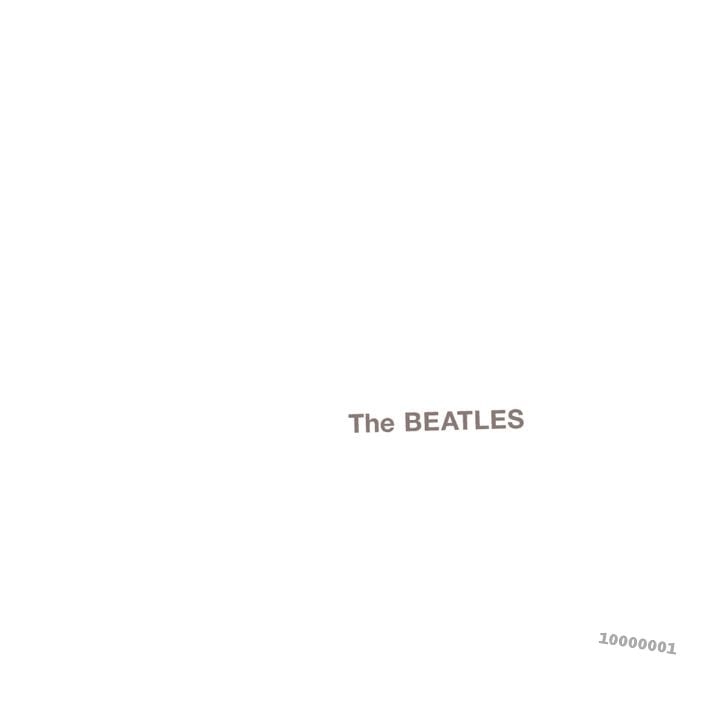
Released in November, 1968, The Beatles’ self-titled double LP stripped away psychedelic excess to reveal a fractured band at the absolute peak of its creative power
By late 1968, the technicolor dream of the Summer of Love had largely faded, replaced by political upheaval, cultural disillusionment, and, inside Abbey Road Studios, a palpable sense of friction. Just over a year after Sgt. Pepper’s Lonely Hearts Club Band had united the world in a single, kaleidoscopic vision, The Beatles arrived at a radical visual and sonic reset. When the band released their ninth studio album on November 22, 1968, there were no velvet uniforms, no marching band iconography, and no ornate gatefold collages. There was only a stark, minimalist sleeve designed by pop artist Richard Hamilton—entirely blank save for the embossed words "The Beatles" and a stamped serial number.
Colloquially christened The White Album, the 30-track double LP was a deliberate blank canvas. Inside that pristine white jacket lay a sprawling, contradictory, and endlessly fascinating portrait of four distinct artists pulling in entirely different directions—and somehow creating a singular masterpiece in the process.
The seeds of this creative explosion were planted thousands of miles away from London. In February 1968, John Lennon, Paul McCartney, George Harrison, and Ringo Starr traveled to Rishikesh, India, to study Transcendental Meditation under the Maharishi Mahesh Yogi. Cut off from the deafening roar of Beatlemania and stripped of their usual studio gadgetry, the band had little to do between meditation sessions other than sit on bungalows with acoustic guitars. The result was an unprecedented burst of songwriting. Freed from the heavy orchestral arrangements of their psychedelic era, Lennon and McCartney returned to the fundamentals of folk and blues, while Harrison found a newfound confidence as a writer.
By the time the sessions began at EMI’s Abbey Road Studios in May 1968, the group was sitting on a mountain of material. Rather than whittling the tracks down to a standard 12- or 14-song record, they opted for a double album—a move that allowed room for every whim, experiment, and stylistic detour.
The resulting 93 minutes of music plays less like a cohesive concept album and more like a curated radio broadcast from the collective subconscious of the late 1960s. It opens with the jet-engine roar of "Back in the U.S.S.R.," McCartney’s affectionate, high-octane homage to Chuck Berry and The Beach Boys, before gliding seamlessly into "Dear Prudence," Lennon’s hypnotic, finger-picked plea to Mia Farrow’s sister to emerge from her meditation hut in Rishikesh.
From there, the stylistic whiplash becomes the record's defining feature. McCartney bounces from the infectious, Jamaican-inflected ska of "Ob-La-Di, Ob-La-Da" to the ferocious, proto-heavy-metal shriek of "Helter Skelter," a track born out of his desire to record the loudest, dirtiest song imaginable. Meanwhile, Harrison delivered one of the band’s crown jewels with "While My Guitar Gently Weeps," a brooding, philosophical ballad elevated by a soaring, uncredited lead guitar performance from his close friend Eric Clapton. And then there was "Revolution 9," Lennon and Yoko Ono’s eight-minute avant-garde sound collage—a polarizing, tape-looped fever dream that pushed mainstream pop listeners to their absolute limits.
Behind the scenes, however, the making of The White Album was notoriously fraught. The sessions stretched across five tense months, marked by late-night arguments, creative isolation, and the unprecedented presence of Yoko Ono inside the control room. At times, the four Beatles functioned less as a unified band and more as solo artists utilizing the other three as backing musicians. In August, frustrated by the atmosphere and feeling unappreciated, Ringo Starr briefly quit the group, prompting McCartney to step behind the drum kit for "Back in the U.S.S.R." and "Dear Prudence" before Starr was coaxed back with flowers draped across his drum set.
Yet, remarkably, the internal tension never dulled the music; instead, it gave the record an edge and immediacy that their earlier, more polished work lacked. Without the unifying gloss of producer George Martin’s heavy orchestrations—Martin himself took an extended vacation during the sessions, leaving much of the engineering to a young Chris Thomas—the songs sounded raw, intimate, and fiercely alive.
Upon its release in November 1968, critics were initially divided by the album's sheer sprawl, with some questioning whether the band needed an editor. Audiences, however, embraced the chaos wholeheartedly. The White Album dominated charts worldwide, spending eight non-consecutive weeks at No. 1 in the United Kingdom and nine weeks at the top of the Billboard 200 in the United States. Decades later, its commercial staying power remains unmatched within the band's catalog; certified 24x Platinum by the Recording Industry Association of America (RIAA), it stands as The Beatles' highest-certified album in the U.S.
More than half a century after its release, The White Album endures precisely because it refuses to be pinned down. By abandoning the illusion of monolithic harmony, The Beatles captured something far more enduring: the sound of four brilliant, restless minds fracturing and colliding in real time, leaving behind a sprawling, imperfect monument to boundless creativity.
Sources
- Recording Industry Association of America
- Official Charts Company
- Billboard
- Lewisohn, Mark. The Complete Beatles Recording Sessions: The Official Story of the Abbey Road Years 1962–1970. Hamlyn, 1988
- The Beatles Anthology. Chronicle Books, 2000
- Wikipedia
 New Music Monday: Post-hardcore, cinematic pop, heavy duos, and western grunge rock the chart
 Remembering Michael Hutchence and the electric legacy of INXS
 B-Side Stories: "For What It’s Worth" — How a Sunset Strip curfew sparked an accidental anthem
 Western Space Grunge Goes Platinum: Dexter and the Moonrocks Conquer 2026
 On This Day in 1964, The Supremes break the "glass ceiling"











Comments
Add a comment